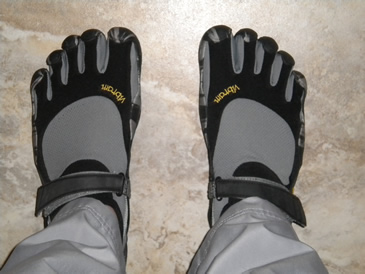
I don’t know what possessed me, but I bought a pair of Vibram FiveFingers running shoes recently – an act that can legitimately be described as an anti-fashion statement. If you are not familiar with Vibram FiveFingers shoes, they are part of a new trend in barefoot running, and in looking uncool.
The primary theory underpinning barefoot running is that humans are evolutionarily designed to run barefoot and that traditional running shoes force us to run in an unnatural way. This shoe-influenced style of running encourages improper biomechanics, which affects your hips, back, and I think even your Klout score.
I will not speak to the validity of these assertions and will say the Vibram site is pretty light on research supporting the claims. But the premise seems logical, so I decided to give the shoes a try.
However, my experience with the FiveFingers provided me with something more valuable than a new way of running; it provided me with a sharp reminder of a business principle that most of us know intuitively but rarely pay attention to:
Your tools dictate the limits of your performance.
If you don’t believe me, let me tell you about my new shoes…
Vibram FiveFingers and the Lesson of Sore Muscles
The great transformation that is supposed to occur as a result of barefoot running is that you transition from a heel-strike to a ball-of-foot/mid-foot-strike running style. Your heel was not designed to bear the brunt of running, and as soon as you try running barefoot, you will realize that this is true.
What you don’t realize until you get out and pound some pavement is how completely different running on the balls of your feet is. You might think it is a minor adjustment (as I did); it is not. It is a completely different way to run! The best analogy that I can give would be this: imagine running on your tip toes – for distance.
As advised on the Vibram website, I eased into running with the shoes. I performed 3 short runs (3 sets of 3-5% normal distance) that were interspersed with walking, and I took a few days off between runs. Here is a quick take of my first three days:
- Day 1: Basically ran in my traditional heel style. Heels were bruised and sore for days. Tried running in new style but had trouble adjusting.
- Day 2: Tried running with a ball strike again. Very awkward. Felt like I was running on my toes, but started getting the hang of it. Calves, quads, hips, and ankles(!) all really sore the next day. It felt bizarre. The style makes it almost impossible to run slowly. Balls of feet were sore but not for long.
- Day 3: Same results as Day 2, just a little less traumatic.
I do not know if my FiveFingers running shoes are better for me or not, but what I realized using them is how much the tool (the shoes I have worn) has dictated my form. Think about it: millions of years of evolution designed us to run one way, and wearing Nikes since we were kids has completely altered that. If a tool can override such hard-wired, innate execution, what are our business tools doing to direct our performance at work?
Are Your Tools Dictating Your Performance?
Marshall McLuhan once famously opined that the medium is the message. While dissecting this comment is way past the scope of this post, it is safe to say that McLuhan was asserting that the medium has its own characteristics and impact regardless of the content it delivers. The tools we use in business are no different.
Whether it is our software, our phone system, or our ad agency, the products/services we choose have their own characteristics, and these characteristics create constraints which steer our performance in certain directions. For instance, I’ve noticed that I interact differently with Twitter when I am logging on through HootSuite as opposed to directly through the Twitter interface. When I am on Hootsuite, I am more focused on messaging; when I am on Twitter I am focused on followers.
I witnessed another example of this phenomena just recently in one of my retail businesses. Our employment advertising in this business has been heavily shaped by the included options that were offered through our payroll service. Yet, looking at our results for the past year, we have been seeing a decline in effectiveness. We should have reassessed earlier; yet, the tool we have been using for years directed our approach.
So, my question is simple: what tools are you using – in your business, on your blog, in your life – that are dictating the limits of your performance? When was the last time you took a step back and asked yourself: is this tool what I need to take me where I want to go? If not, maybe it’s time to take a look.
After all, taking a step back is never a bad idea – just make sure you land on the ball of your foot.


This information is very usefull for me. I shall definatelly try this one. I found one of the best link. Nico Neugeboren
Yep, you picked a real winner in those shoes, if you were going for the “uncool” look. I remember years ago how a family friend tried to teach my siblings and me how to run on the balls of our feet. Seems like it was awkward but doable. (But, probably because of the pain factor, it didn’t stick as “the” way to run.)
Your article makes me think of another tool that impacts performance — environment. This week I’m away from home, spending time with the grandkids. Just being in their environment changes the way I move and get things done. Normally, I’d be a bit uptight, focusing on how much I still haven’t done. This time, I’m allowing the environment to become a tool that furthers my goal of getting more exercise. For example, I’m far more active at odd times, playing basketball or soccer, or even the Wii — not only when I “have time” but when they say, “Grandma, come on!”
Sometimes we pick a tool; other times we need to recognize something that otherwise wouldn’t even be considered a tool of value. Like switching shoes and running more naturally on the balls of your feet.
Vernessa Taylor recently wrote about this…No Hardhats Allowed – Online Project Management For The Rest of Us
Hi Vernessa,
Yeah.. the shoes should definitely be filed under the category “function over form.”
You make an excellent point about viewing your environment as a tool. I think anyone who writes/blogs must be aware of using the environment as a tool. Some people prefer a home office, some prefer coffee shops (my fav!), and so on. But it also extends to B&M businesses. For instance, the setting you choose for a meeting can certainly impact the behavior of the participants.
And you’re right… sometimes it’s not always about choosing a different tool as it is about using the tools at your disposal. I think as long as you are cognizant of how the tool is directing your performance, you can make informed decisions that allow you to be more effective.
Thanks for stopping by and enjoy your time with your grandkids!
Hi Adam,
I just recently heard about these shoes from my daughter’s boyfriend. I personally can’t even wear the toe socks, so I’m not sure if these are for me either. It’s interesting how you use these shoes as an analogy. Let me think about it. Definitely got my juices flowin.
Kris recently wrote about this…How to Start a Budget
Thanks Kris. The shoes definitely are not for everyone. If you do try them, my advice is to take it slowly.
Each time I have seen these shoes worn by runners, I have always thought they looked very bizarre, but intriguing. It is interesting to hear your experience with them and learn a bit about the science behind them.
I think the point of your article is right on. In most cases most people tend to follow the path of least resistance. This is true with tools, mindset, and relationships. We tend to follow whatever path will get us to our goal in the easiest fashion. Rarely do we consider the repercussions of taking that path. Once we are set on that path we do not to deviate from it.
For us, what was holding us back was not so much a tool but the way we were approached a few of our business processes. Specifically, our sales process. We had to take a step back and reevaluate both our mind set and our approach.
Thanks for stopping by Tom. You’re absolutely right; mindset, behavior patterns, and the like can all be as limiting as tools. Sometimes breaking out of the rut is a simple as stepping back and asking: if I were designing the perfect method today, would it be the one I am using now? If the answer is no, then you have to analyze the costs and benefits of switching. In the end, you may choose to stay with what you have, but at least you are doing so because you evaluated the pros and cons of the alternatives, not just out of habit.
Adam Toporek recently wrote about this…3 Lessons Small Businesses Can Learn from the Best Franchises
Adam,
Awesome post! Sorry to hear that your experience with the Vibram’s Five Fingers were so tough. Bruised heals kinda suck. Regardless, great minds think alike and I am very happy you reached out to me. I look forward to reading your future posts.
@jwsokol
Thanks for stopping by Jason. Really interesting to see that you had written a similar post. I am probably the last person in the world to give running advice; that’s why I stuck to the business advice. I found a great book on barefooting, so maybe I can figure out how to do the running part right!
Adam Toporek recently wrote about this…One of My Guiding Principles